레고 스타일 광고 혁명: 모듈식 LED 장치를 통해 벽 하나가 하루에 10번의 "디지털 변형"을 겪는 방법

For decades, out-of-home advertising relied on fixed, unchanging billboard structures. Once installed, their geometry remained static for years without adaptation. However, the rise of LEGO-style modular displays has disrupted this rigid model.
As a result, advertising spaces become as programmable as the content they present.

At the heart of modern visual marketing lies modular innovation. By adopting standardized, high-performance modules, brands transform walls into dynamic brand canvases. Whether in grand atriums, narrow airport corridors, or pop-up stores, modular LED panels adapt effortlessly. As a result, spatial limitations no longer restrict creative expression. Moreover, a single hardware system can evolve through multiple digital transformations. Consequently, marketing content responds instantly to changing spaces and campaign moments.

1. The Death of the “Fixed Frame”: Embracing the LEGO Logic

The primary limitation of traditional displays (like LCD monitors) is their fixed aspect ratio. You are trapped in a 16:9 box. Modular LED display panels, conversely, operate on the principle of “infinite scalability.”

The Power of Standardized Interlocking

Just as a LEGO brick can become part of a castle or a spaceship, a single LED module—typically a small square or rectangle—serves as a universal building block. Engineers design these modules with high-precision interlocking mechanisms and magnetic connectors.

  • Action: This allows technicians to assemble a massive 4K wall in the morning and disassemble it into ten individual digital pillars by the afternoon.

  • Effect: This “granular” approach to hardware means the advertising wall is no longer a permanent fixture of the building; it is a fluid asset that moves and evolves with the brand’s campaign.

2. Spatial Adaptation: Solving the “Awkward Corner” Problem

Commercial spaces are rarely perfect rectangles. Malls have curved corridors, airports have cylindrical pillars, and flagship stores have narrow, angular stairwells. Standard screens fail in these environments, leaving “dead zones” that waste valuable foot traffic.

Bending Reality with Flexible Modules

Modular technology has evolved to include flexible LED screen modules. These units utilize soft PCB boards and rubberized frames that can bend up to 45 degrees or more.

  • The Curve: Brands can wrap a digital screen around a structural column, turning a visual obstacle into a 360-degree storytelling beacon.

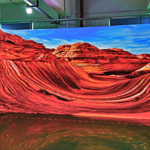
  • The Wave: By alternating concave and convex modules, designers create “ribbon” displays that mimic the flow of water, guiding customers’ eyes through a retail journey.

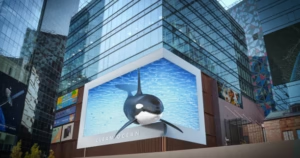
  • The Corner: Right-angle modular units allow for seamless transitions around 90-degree corners, creating a “cube” effect that makes 3D anamorphic content (the “naked eye 3D” effect) possible.

모듈 식 LED 디스플레이 패널

3. The “Metamorphosis” Workflow: One Day, Ten Forms

To grasp its transformative impact, consider a hypothetical “day in the life” scenario.
In this context, a modular LED kit supports a brand’s regional launch event.

  • 09:00 AM (The Grand Opening): The modules are assembled into a massive, flat, seamless LED video wall behind the main stage for the keynote speech.

  • 11:00 AM (The Product Demo): The wall is split. Half the modules form a long, horizontal “digital ticker” above the demo area, while the other half are used as individual “smart pedestals” for product displays.

  • 02:00 PM (The Artistic Interlude): Technicians rearrange the modules into a staggered, “pixel-art” configuration to display abstract digital art that matches the event’s theme.

  • 05:00 PM (The Social Media Hour): The modules are moved to the entrance and stacked into a giant, glowing 3D logo of the brand, serving as the perfect “Instagrammable” photo backdrop.

This level of agility ensures that the hardware investment never sits idle. The “LEGO” nature of the system means the brand only needs to purchase the modules once to unlock a thousand different configurations.

4. Technical Reliability: Why Modular is the “Smart” Choice

Modularity is not just about aesthetics; it is a superior engineering philosophy for long-term maintenance and reliability.

The “Zero-Downtime” Maintenance Model

In a traditional large-format screen, a single internal failure can black out an entire section of the wall, requiring hours of dismantling. In a modular system, the 모듈 식 LED 디스플레이 패널 feature “front-service” accessibility.

  • Hot Swapping: If a single module experiences a pixel failure, a technician uses a magnetic tool to pop out that specific unit and snap in a spare. This process takes less than 60 seconds and does not require shutting down the rest of the display.

  • Distributed Intelligence: Each module contains its own calibration data. When you snap a new module into an existing wall, it automatically syncs its brightness and color balance to match its neighbors, ensuring a perfectly uniform image every time.

5. Driving ROI: The Economics of Flexibility

From a financial perspective, the “LEGO-style” LED revolution changes the ROI calculation for marketing departments.

  • Reduced Logistics Costs: Because the screen breaks down into small, lightweight tiles, it can be transported in standard flight cases rather than requiring specialized flatbed trucks. This makes portable LED advertising viable for global tours.

  • Multi-Site Utility: A brand can use the same 100 modules for a flagship store opening in New York, then ship them to a trade show in Las Vegas, reconfiguring the shape each time to fit the new booth dimensions.

  • Content Synchronization: Modern modular controllers allow for “mapping” any shape. The software automatically detects the layout of the modules, meaning content creators don’t need to re-render videos for every new shape; the system intelligently “flows” the video over the new geometry.

6. Conclusion: The Brand Canvas of the Future

The transition from “static screens” to “modular systems” represents the ultimate maturation of digital signage. By treating advertising walls as a collection of smart, interlocking pixels, we have turned architecture into a living participant in the marketing story.

Modular LED display panels empower brands to be fearless. They can now go wherever the customer is—be it a curved tunnel, a round pillar, or a pop-up art gallery—without sacrificing visual quality. In the future of advertising, the most successful brands will not be those with the biggest screens, but those with the most adaptable ones. The LEGO revolution has arrived, and the only limit to your digital metamorphosis is the boundary of your imagination.

카테고리 태그


고급 플립 칩 LED 디스플레이 고리 LED 디스플레이 솔루션 농구 코트는 디스플레이를 이끌었습니다 원형 LED 디스플레이 스크린 원형 LED 스크린 문제 콘서트 LED 배경 디스플레이 콘서트 LED 패널 크리에이티브 스토어 프론트 LED 간판 디스플레이 곡선 LED 디스플레이 곡선 LED 간판 맞춤형 LED 디스플레이 디자인 맞춤형 농구장 LED 디스플레이 맞춤형 벌크 댄스 플로어 디스플레이 솔루션 D- 킹 농구 코트는 디스플레이를 주도했습니다 D-King LED 솔루션 댄스 플로어 LED 디스플레이 디지털 간판 솔루션 유연한 콘서트 LED 배경 디스플레이 플립 칩 LED 디스플레이 플립 칩 LED 디스플레이 솔루션 플립 칩 대 SMD 바닥 통합 LED 디스플레이 바닥 통합 LED 디스플레이 솔루션 몰입 형 디지털 전시회 디스플레이 실내 LED 디스플레이 대화식 댄스 플로어는 디스플레이 아이디어를 LED했습니다 LED 디스플레이 사용자 정의 공간 브랜딩을위한 LED 디스플레이 LED 디스플레이 공급업체 박물관을위한 LED 바닥 디스플레이 LED 바닥 디스플레이 공급 업체 LED 유지보수 솔루션 LED 스크린 서비스 가능성 LED 사이드 라인 디스플레이 로드 베어링 디자인 바닥 통합 LED 디스플레이 모듈식 LED 디스플레이 모듈 식 LED 디스플레이 패널 다용도 스타디움 디스플레이 임대 단계 LED 디스플레이 링 LED 디스플레이 시스템 사이드 라인은 콘서트에서 이끌었습니다 무대 비디오 월 스토어 프론트 LED 간판 디스플레이 전통적인 SMD 기술 넓은 시청형 LED 디스플레이