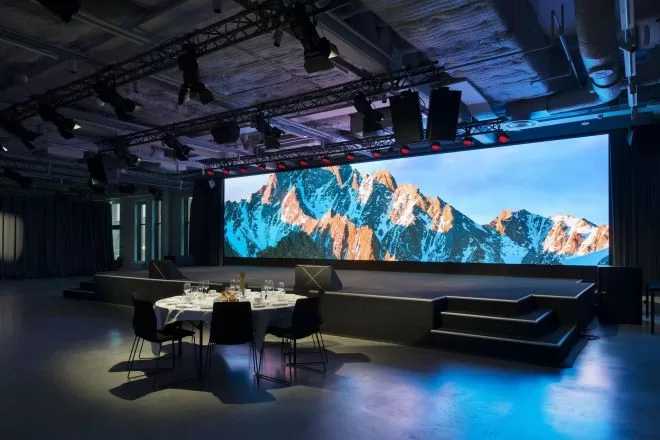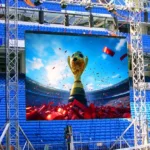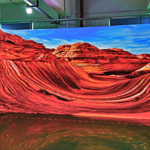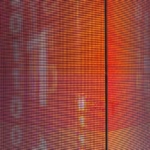
In professional filming environments, 小间距LED显示屏 have become a critical visual tool for broadcast studios, XR virtual production, and commercial video production. However, many production teams still face two major challenges when capturing LED screens with cameras: moiré effects and visible scan lines。
These unwanted patterns can reduce image quality, damage visual consistency, and affect the final production experience. Therefore, choosing the right LED display technology, optimizing refresh rate, controlling camera settings, and selecting advanced display structures become essential steps.
For modern filmmakers, a high-performance 小间距LED显示屏 is not only about pixel density. Instead, it must deliver stable refresh performance, accurate image reproduction, and camera-friendly characteristics.
This article explains how LED display refresh rate, shutter speed, anti-glare mask design, COB LED technology, and Micro LED solutions work together to eliminate moiré patterns and scan lines during filming.
What Causes the Moiré Effect on LED Displays During Filming?
Moiré effect appears when the camera sensor captures interference between two repeating patterns:
- The LED display pixel structure
- The camera sensor pixel grid
When these patterns overlap at specific angles or frequencies, the camera produces unwanted waves, stripes, or color distortions.
For example, traditional LED screens with larger pixel pitches often create visible pixel structures when filmed at close distances. As a result, cameras may capture inconsistent brightness distribution between LED modules.
Moreover, virtual production environments increase this challenge because:
- Cameras frequently move close to the LED wall
- High-resolution cameras capture more pixel details
- Different frame rates and shutter speeds affect image synchronization
Therefore, production teams require camera-friendly LED displays that minimize pixel interference.
1. Choose Higher Refresh Rate LED Displays to Reduce Scan Lines
Refresh rate is one of the most important factors affecting LED screen performance during filming.
The refresh rate describes how many times the LED display updates images per second. A higher refresh rate creates smoother visual output and reduces flickering captured by cameras.
3840Hz vs 7680Hz LED Display Refresh Rate
For many commercial applications, a 3840Hz LED display already provides stable image performance. However, professional filming environments often demand higher specifications.
一个 7680Hz LED display offers several advantages:
- Better camera synchronization
- Reduced horizontal scan lines
- Lower flicker visibility
- Improved slow-motion filming performance
- More stable images under high-speed cameras
Especially in XR virtual production, cameras frequently use different shutter angles and frame rates. Therefore, higher refresh rates provide more flexibility for production teams.
However, refresh rate alone cannot eliminate moiré effects. Display structure, pixel design, and optical treatment also play important roles.

2. Match Camera Shutter Speed with LED Display Performance
Even with a high refresh rate LED display, incorrect camera settings can still create scan lines.
The camera shutter speed determines how the sensor captures LED refresh cycles.
For example:
- A mismatched shutter speed may capture incomplete LED refresh patterns.
- A synchronized shutter setting creates cleaner images.
- Higher frame rates require better LED display response.
Professional filming teams often adjust:
- Shutter angle
- Frame rate
- Exposure settings
- Camera synchronization frequency
Therefore, LED display suppliers should provide screens with stable refresh performance to support flexible camera adjustment.
A high-quality modular LED display for virtual production should maintain consistent brightness and color performance under different filming conditions.
3. Use Fine Pitch LED Display Technology for Better Camera Results
Pixel pitch directly affects how an LED screen appears through a camera lens.
A smaller pixel pitch creates a smoother visual surface because pixels become less noticeable.
Common fine pitch LED display advantages include:
Smaller Pixel Structure
Fine pitch LED displays use tighter LED arrangements. Therefore, cameras capture a more continuous image surface instead of individual LED points.
Higher Image Resolution
A smaller pixel pitch supports:
- 4K production
- 8K content creation
- Close-up camera shooting
- Large-format virtual backgrounds
Better Visual Uniformity
High-quality LED modules reduce brightness differences between pixels. As a result, cameras capture more natural images.
For broadcast studios and XR stages, fine-pitch LED displays provide a better balance between resolution, reliability, and filming performance.
4. COB LED Display Technology Improves Camera-Friendly Performance
Compared with traditional SMD LED modules, COB LED显示屏 offer unique advantages for filming applications.
COB technology directly packages LED chips onto the PCB surface. This design reduces structural gaps between LED components.
As a result, COB LED displays provide:
- Higher pixel protection
- Improved surface flatness
- Reduced light scattering
- Better close-up shooting performance
Furthermore, COB LED technology creates a smoother display surface. Therefore, cameras capture fewer reflections and less visible pixel structure.
For high-end XR virtual production projects, COB LED displays are increasingly becoming a preferred solution.
5. Anti-Glare Mask Design Reduces Reflection and Image Distortion
Lighting conditions strongly affect LED screen filming results.
In studios and virtual production environments, multiple light sources can create reflections on LED panels. These reflections may increase image distortion and reduce camera consistency.
一个 anti-glare mask helps solve this issue by controlling surface reflection.
High-quality anti-glare LED displays provide:
- Reduced external light reflection
- Better contrast performance
- More natural camera images
- Improved shooting stability
Additionally, matte surface treatments help cameras capture cleaner backgrounds without unwanted highlights.
Therefore, anti-glare technology becomes especially valuable for:
- Film studios
- Television production
- XR virtual stages
- Advertising video production
6. Micro LED Displays Provide the Ultimate Solution for Virtual Production
Micro LED technology represents the next generation of LED display development.
Unlike traditional LED solutions, Micro LED uses extremely small LED chips with precise light control.
Key advantages include:
- Ultra-fine pixel pitch
- Exceptional brightness control
- High contrast ratio
- Superior image accuracy
- Excellent camera compatibility
For large-scale virtual production studios, Micro LED displays can provide highly realistic backgrounds while reducing moiré risks.
Although Micro LED technology currently requires higher investment, it offers strong advantages for premium film production applications.
Comparison: Different LED Display Technologies for Filming
| LED Display Technology | Moiré Control | Camera Performance | Recommended Application |
|---|---|---|---|
| Standard SMD LED Display | Medium | Suitable for normal video | Commercial displays |
| 小间距LED显示屏 | High | Good close-up performance | Broadcast studios |
| COB LED Display | Very High | Excellent camera results | XR production |
| Micro LED Display | Excellent | Premium virtual production | Film studios |
How to Select the Right Modular LED Display for Camera Shooting?
When choosing a modular LED display for filming, buyers should evaluate several factors.
1. Refresh Rate
Choose:
- 3840Hz for professional commercial applications
- 7680Hz for demanding broadcast and XR environments
2. Pixel Pitch
Smaller pixel pitch improves:
- Close-range shooting
- Image details
- Background realism
3. Surface Treatment
Anti-glare and matte finishes reduce:
- Reflection problems
- Light interference
- Camera artifacts
4. LED Packaging Technology
COB and Micro LED solutions provide better camera compatibility than traditional LED structures.
5. System Stability
A professional LED display should maintain:
- 均匀的亮度
- Accurate color calibration
- Stable signal transmission
- Consistent module performance

Why D-King Modular LED Displays Are Designed for Professional Filming
D-King focuses on customized modular LED display solutions for demanding commercial and professional applications.
Our LED displays integrate advanced technologies, including:
- High refresh rate design
- Fine pitch LED modules
- Camera-friendly optical structures
- Anti-glare surface solutions
- COB and advanced LED technologies
Therefore, D-King LED displays help production teams achieve cleaner images, smoother backgrounds, and more realistic visual experiences.
Whether used in broadcast studios, XR virtual production stages, or commercial filming environments, our solutions provide reliable performance for modern content creation.
Conclusion: Reduce Moiré and Scan Lines with the Right LED Display Solution
A single factor does not cause moiré effects and scan lines. Instead, they result from the interaction between LED display structure, refresh rate, camera settings, and lighting conditions.
To achieve professional filming results, production teams should combine:
- High refresh rate LED displays
- Fine pixel pitch technology
- Proper camera synchronization
- Anti-glare optical design
- COB or Micro LED solutions
By selecting the right 小间距LED显示屏, filmmakers can achieve smoother images, fewer visual artifacts, and higher-quality production results.
For broadcast, XR virtual production, and studio applications, a camera-friendly LED display solution is no longer optional. It has become a key factor in creating realistic and professional visual content.