A led digital advertising display gives businesses a flexible way to deliver advertising messages, promote products, and manage commercial content. Unlike static printed posters, digital LED screens can display multiple campaigns in scheduled rotation. They also support remote content updates and flexible advertising arrangements.
For businesses with valuable storefronts, building facades, or public-facing spaces, this technology creates new opportunities to use advertising space more efficiently. A well-planned digital out-of-home (DOOH) display can support brand awareness, promotional campaigns, and third-party advertising.
However, the commercial value of an LED advertising screen depends on more than screen size and brightness. Businesses must also consider audience visibility, content scheduling, display performance, operating costs, and advertising demand.
This guide explains the business benefits of digital LED advertising displays, how cloud-based content management works, and where companies can apply these solutions.
1. The Commercial Shift from Static Signage to Digital Out-of-Home (DOOH)
Traditional printed signage remains useful for simple, long-term messages. However, it becomes less flexible when businesses need frequent campaign updates or multiple advertising messages.
Digital out-of-home advertising addresses these limitations through electronic displays in public and commercial environments.
1.1 Static Advertising vs. Digital LED Advertising Displays
A printed billboard usually presents one fixed advertising message. Changing that message requires new artwork, printing, transportation, and installation.
An LED digital advertising display uses electronic content instead. Operators can schedule different advertisements without replacing physical posters.
| Comparison Factor | Static Printed Signage | Digital LED Advertising Display |
|---|---|---|
| Content changes | Requires new printing and installation | Supports electronic content updates |
| Advertising messages | Usually one design per display surface | Multiple advertisements can rotate |
| Campaign scheduling | Manual replacement or coordination | Supports scheduled playback |
| Remote management | Generally unavailable | Available with compatible networked CMS |
| Visual presentation | Fixed images and graphics | Supports video, animation, and images |
| Multi-location management | Requires separate physical coordination | Can support centralized management |
| Operating expenses | Repeated printing and installation costs | Electricity, maintenance, software, and content costs |
The main difference is operational flexibility. Digital displays allow businesses to manage advertising content without repeatedly changing physical materials.
However, digital signage also introduces new costs. Businesses should evaluate electricity consumption, equipment maintenance, software services, installation, and network requirements.
1.2 Why Businesses Are Adopting DOOH Advertising
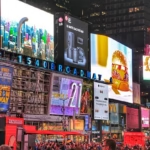
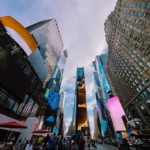
Digital out-of-home advertising places digital messages in locations where people live, work, shop, and travel.
Common DOOH environments include:
Shopping centers and retail streets.
Commercial building facades.
Transportation hubs and public spaces.
Sports venues and entertainment facilities.
Automotive dealerships and exhibition areas.
Hotels, restaurants, and business complexes.
Businesses can use these displays for their own promotions or sell advertising time to external brands.
This creates two potential business models.
Owned-media model: A company uses its display to promote its products, services, events, and brand campaigns.
Advertising-inventory model: A property owner or media operator sells scheduled advertising slots to other businesses.
The second model can create an additional revenue stream. However, its commercial success depends on location quality, audience traffic, advertiser demand, and the pricing strategy.
1.3 When Should a Business Upgrade to Digital Signage?
Not every printed sign needs to become a digital screen. The upgrade makes more sense when a business has frequent content changes or valuable advertising space.
Consider an LED advertising display when:
Promotional campaigns change frequently.
Multiple brands need access to the same advertising space.
A building has strong visibility from roads or pedestrian areas.
The business operates several advertising locations.
Marketing teams need centralized content control.
The company wants to develop a commercial advertising inventory.
For a single message that remains unchanged for years, printed signage may remain more economical.
The best decision depends on the expected use of the display throughout its operating life.
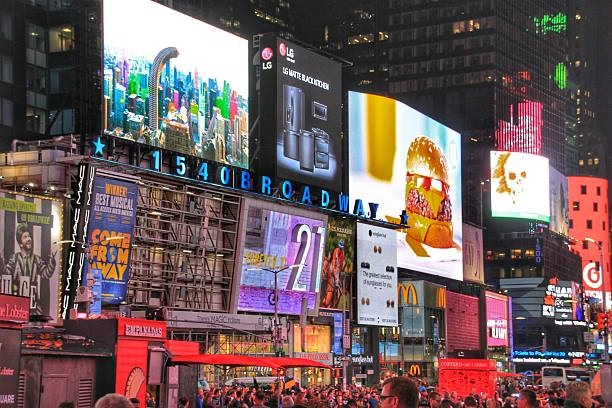
2. Key Business Benefits: Higher ROI, Dynamic Scheduling, and Multi-Ad Slots
The commercial value of an LED advertising screen comes from how effectively a business uses its display space.
Instead of presenting one fixed message, the screen can deliver several campaigns across different time periods. This creates more flexible advertising inventory and campaign management opportunities.
2.1 Improve Advertising Space Utilization with Multiple Ad Slots
A static billboard usually dedicates its entire surface to one advertiser during a campaign period.
A digital LED display can divide its playback schedule among multiple advertisers. Each advertiser receives a defined time slot within a repeating content loop.
For example, a business may schedule:
| Content Slot | Advertiser | Playback Duration |
|---|---|---|
| Slot 1 | Automotive brand | 15 seconds |
| Slot 2 | Financial services company | 15 seconds |
| Slot 3 | Retail promotion | 15 seconds |
| Slot 4 | Property development project | 15 seconds |
| Slot 5 | Company-owned campaign | 15 seconds |
This example uses a 75-second loop. Each advertisement receives one playback opportunity per loop.
A business can adjust the number of advertisers and playback frequency according to its commercial strategy.
However, more advertising slots do not automatically produce higher revenue. Excessive rotation can reduce individual advertiser exposure and make the display less attractive to buyers.
Operators should balance advertiser demand, playback frequency, audience attention, and campaign pricing.
2.2 Increase Campaign Flexibility Through Dynamic Scheduling
Digital advertising campaigns often change with market conditions.
A retailer may promote a weekend discount. A dealership may launch a new vehicle campaign. A financial institution may announce a seasonal service.
An LED digital advertising display allows operators to schedule different content for specific dates and time periods.
Examples include:
Morning campaigns targeting commuters.
Lunchtime promotions for nearby shoppers.
Evening campaigns for entertainment and dining.
Weekend promotions for shopping districts.
Holiday advertising for seasonal retail campaigns.
This approach helps businesses align advertising messages with expected audience behavior.
Operators should also consider local regulations, display brightness restrictions, and permitted operating hours when planning outdoor campaigns.
2.3 Improve Brand Visibility with Dynamic Visual Content
LED displays support visual formats that printed posters cannot provide in the same way.
Depending on the display and playback system, businesses can present:
High-resolution product images.
Promotional videos.
Animated graphics.
Brand logos and campaign messages.
Event announcements.
Real-time information feeds.
Movement and changing content can attract attention in suitable viewing environments. However, visual quality depends on more than animation.
Important factors include pixel pitch, viewing distance, brightness, contrast, refresh rate, grayscale performance, and content design.
For example, a large outdoor LED billboard beside a road requires different specifications from a fine-pitch display inside a financial building.
2.4 Understand the Potential Return on Investment
A digital advertising screen can create commercial value through improved advertising utilization and reduced dependence on printed materials.
Businesses should evaluate both direct revenue and operational savings.
A basic ROI framework can include:
Advertising Revenue
Number of advertisers.
Price per advertising slot.
Campaign duration.
Playback frequency.
Available operating hours.
Actual advertiser occupancy.
Operating Costs
Initial screen and control-system investment.
Structural installation and electrical work.
Electricity consumption.
Maintenance and spare parts.
Content production and management.
Network connectivity and software services.
Site rental, permits, and insurance where applicable.
A simplified calculation is:
Net Operating Return = Advertising Revenue − Operating Costs
For a more complete investment assessment, businesses should also consider the initial capital investment, expected operating life, depreciation, and financing costs.
A digital display does not guarantee a higher ROI. Its performance depends on the location, audience quality, advertiser demand, operating efficiency, and total cost of ownership.
3. Cloud-Based Content Management Systems (CMS) and Programmatic Ad Tech
A digital LED advertising display needs more than an LED cabinet and a power supply. It also requires a reliable content delivery and management system.
A content management system (CMS) helps operators upload, organize, schedule, and distribute advertising materials.
When connected to compatible network infrastructure, a cloud-based CMS can manage multiple displays from a centralized platform.
3.1 How a Cloud-Based LED Display CMS Works
A typical cloud-based content management workflow includes several stages.
Step 1: Upload Advertising Content
Marketing teams upload approved images, videos, and campaign materials to the CMS.
Step 2: Organize Playlists
Operators arrange content into playlists. They can define playback order, duration, and repetition rules.
Step 3: Set Scheduling Rules
The CMS assigns content to specific displays, dates, and time periods.
Step 4: Distribute Content Remotely
The platform sends approved playlists to connected LED display players through an available network connection.
Step 5: Monitor Playback Status
Depending on the system, operators may check device connectivity, playback status, and selected operating information.
<em>Note: Actual functions depend on the CMS, LED controller, playback hardware, network configuration, and software permissions.</em>
3.2 Manage Multiple LED Advertising Screens from One Platform
For companies operating screens in different cities, centralized management can reduce repetitive manual work.
A multi-location CMS may allow operators to:
Group screens by city, building, or business unit.
Assign different playlists to individual displays.
Schedule campaigns across selected locations.
Update content without visiting every site.
Apply time-based advertising rules.
Review device and playback status.
Manage user permissions for different teams.
For example, a retail chain may run one national campaign across all stores while maintaining separate local promotions.
A financial group may distribute corporate branding content across several buildings. Local marketing teams can then manage approved regional messages.
Centralized control improves coordination. However, it does not eliminate the need for local network support, equipment maintenance, or on-site troubleshooting.
3.3 What Is Programmatic DOOH Advertising?
Programmatic DOOH refers to the automated buying, selling, and delivery of digital out-of-home advertising inventory through compatible advertising technology platforms.
Traditional digital signage scheduling often relies on manually arranged playlists. Programmatic systems can connect available screen inventory with advertising demand through defined rules and transactions.
A simplified process includes:
A media operator makes advertising inventory available.
An advertiser or agency defines campaign requirements.
A compatible platform evaluates available inventory.
The system selects suitable placements based on campaign rules.
Approved advertising content is delivered for scheduled playback.
The operator or platform collects available delivery and reporting data.
Programmatic advertising may support factors such as location, time, audience estimates, campaign budgets, and inventory availability.
However, not every LED display supports programmatic advertising directly. Integration may require compatible CMS software, ad-serving platforms, data connections, and commercial agreements.
3.4 CMS vs. Programmatic Advertising: What Is the Difference?
These technologies serve related but different purposes.
| Feature | Content Management System (CMS) | Programmatic DOOH Platform |
|---|---|---|
| Main purpose | Manage and distribute screen content | Automate advertising transactions and delivery |
| Content upload | Usually supported | Depends on integration |
| Playlist scheduling | Core function | May use connected scheduling rules |
| Screen grouping | Common feature | Depends on inventory integration |
| Advertiser access | May support account permissions | Supports campaign-side access |
| Ad inventory trading | Not necessarily included | Core commercial function |
| Playback monitoring | Depends on system | May connect to delivery reporting |
A CMS is essential for organized digital signage operations. Programmatic technology is an additional layer for businesses that want to commercialize advertising inventory through automated platforms.
3.5 What Businesses Should Check Before Choosing a CMS
A suitable CMS should match the scale and technical requirements of the advertising network.
Before purchasing, businesses should evaluate:
Device compatibility: Does the CMS work with the selected LED controller and playback hardware?
Network requirements: Does it support the available wired or wireless connection?
Scheduling functions: Can it handle recurring campaigns and time-based playlists?
Multi-user permissions: Can administrators control access for different teams?
Playback verification: Can operators confirm whether content played successfully?
Remote maintenance: Does the system support device monitoring and troubleshooting?
Security: Does it provide appropriate user authentication and access controls?
Scalability: Can it support additional displays and locations as the network grows?
Businesses should confirm these capabilities with the LED display supplier and software provider before finalizing the system configuration.
4. Core Business Applications: Auto Dealerships, Financial Buildings, and Sports Venues
A digital LED advertising display can serve different commercial purposes depending on its installation environment.
Screen size, pixel pitch, brightness, protection level, structure, and content strategy should match the location.
4.1 Automotive Dealerships and 4S Stores
Automotive dealerships use digital displays to promote vehicle launches, financing offers, brand campaigns, and showroom events.
Large outdoor LED screens can increase the visibility of dealership messages from nearby roads. Indoor displays can support product demonstrations and brand storytelling.
<em>Common applications:</em>
New vehicle launch announcements.
Model comparisons and promotional videos.
Seasonal sales campaigns.
Financing and service promotions.
Brand identity displays.
After-sales service information.
Key selection considerations:
For outdoor dealership facades, buyers should evaluate sunlight readability, weather protection, structural installation, and maintenance access.
For indoor showrooms, viewing distance, pixel pitch, image detail, color performance, and screen integration with the interior design are important.
The display should support the dealership’s actual content strategy rather than simply maximize screen size.
4.2 Financial Buildings and Commercial Real Estate
Banks, insurance companies, financial institutions, and commercial property owners often use LED displays to strengthen brand visibility.
Large building-mounted screens can present corporate announcements, brand campaigns, public information, and approved third-party advertising.
<em>Common applications:</em>
Corporate brand promotion.
Financial product campaigns.
Building identity displays.
Commercial property advertising.
Public information and event announcements.
Third-party advertising inventory.
Key selection considerations:
Building facade installations require careful structural assessment. Engineers should evaluate screen weight, wind load, mounting points, support structures, and local building requirements.
Brightness control is also important. The screen should remain visible under suitable daylight conditions without creating unnecessary glare at night.
For high-rise installations, maintenance access and equipment replacement procedures deserve particular attention.
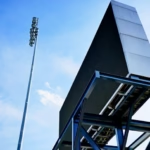
4.3 Sports Venues and Stadium Advertising
Sports venues offer valuable advertising opportunities because they attract concentrated audiences during games, competitions, and entertainment events.
LED advertising displays can support sponsors, venue partners, event organizers, and commercial advertisers.
<em>Common applications:</em>
Perimeter advertising around playing areas.
Stadium facade displays.
Entrance and ticketing-area promotions.
Scoreboard advertising.
Sponsor announcements.
Event schedules and public information.
Key selection considerations:
Sports venue displays may require high refresh rates, stable playback, suitable brightness, and reliable content switching.
For perimeter screens, buyers should also consider viewing angles, impact protection, cabinet design, and access for maintenance.
The display configuration must match the venue’s operating environment and safety requirements.
4.4 Other Commercial Applications
Beyond these three sectors, LED advertising screens can serve many business environments.
| Business Environment | Typical Advertising Purpose | Important Considerations |
|---|---|---|
| Shopping malls | Retail promotions and brand campaigns | Indoor brightness, viewing distance, content scheduling |
| Airports | Brand advertising and passenger information | Continuous operation, content reliability, maintenance access |
| Hotels | Event promotion and brand messaging | Interior design, viewing angles, operating schedule |
| Transportation hubs | Public campaigns and commercial advertising | Ambient light, installation safety, local regulations |
| Retail storefronts | Product launches and promotional offers | Window visibility, heat management, screen size |
| Commercial plazas | Shared advertising inventory | Audience exposure, screen placement, CMS management |
The right solution depends on audience behavior, viewing conditions, installation limitations, and business objectives.
5. How to Select the Right LED Digital Advertising Display for Your Business
A commercial LED display is a long-term investment. Buyers should evaluate technical specifications and operating requirements before choosing a supplier.
5.1 Match Pixel Pitch to Viewing Distance
Pixel pitch refers to the distance between the centers of adjacent LED pixels.
A smaller pixel pitch generally provides higher pixel density and supports closer viewing. A larger pitch may be suitable for displays viewed from greater distances.
For example:
Indoor retail displays may require finer pixel pitch for close viewing.
Building facade screens may use larger pixel pitch for distant audiences.
Stadium advertising screens should match the viewing distance and audience position.
The selection should consider screen dimensions, content resolution, viewing distance, and budget together.
5.2 Check Brightness and Environmental Protection
Outdoor LED advertising screens face changing ambient light, rain, dust, and temperature conditions.
Buyers should review:
Maximum brightness and adjustable brightness settings.
Daytime visibility and nighttime dimming.
Front and rear protection ratings.
Operating temperature range.
Heat dissipation design.
Power supply and electrical protection.
An IP rating describes protection under defined test conditions. It does not guarantee resistance to every weather condition or installation environment.
The actual protection requirements depend on the screen location and cabinet design.
5.3 Evaluate Refresh Rate and Image Performance
Advertising content may include text, animation, video, and branded graphics.
Image performance should match the intended content and viewing environment.
Important specifications include:
Refresh rate.
Grayscale performance.
Contrast ratio.
Color consistency.
Viewing angle.
Brightness uniformity.
For displays that appear in camera recordings or live broadcasts, buyers should also confirm camera compatibility under the intended settings.
5.4 Consider Installation, Maintenance, and Total Cost
The purchase price is only one part of the total investment.
Businesses should also evaluate installation, supporting structures, electrical systems, network connections, CMS licensing, spare parts, and maintenance access.
Before placing an order, request clear information about:
Cabinet dimensions and weight.
Installation and mounting requirements.
Power consumption data.
Controller and CMS compatibility.
Spare parts availability.
Warranty terms and service responsibilities.
Recommended maintenance procedures.
A supplier should help buyers match the display configuration to the site conditions and intended commercial use.
6. Frequently Asked Questions About LED Digital Advertising Displays
Q1: What is an LED digital advertising display?
An LED digital advertising display is an electronic screen that uses light-emitting diodes to present advertising content. Businesses can display images, videos, animations, and scheduled promotional messages.
Q2: What is the difference between a digital billboard and a printed billboard?
A printed billboard presents a fixed physical advertisement. A digital billboard displays electronic content and can rotate multiple campaigns through a scheduled playback system.
Digital displays offer more flexible content management. However, they also require electricity, equipment maintenance, and compatible control systems.
Q3: Can businesses manage LED advertising screens remotely?
Yes, when the display uses a compatible networked CMS and playback system. Operators can upload content, arrange playlists, and schedule campaigns remotely.
The available functions depend on the software, controller, network connection, and user permissions.
Q4: Can one LED screen display advertisements from multiple brands?
Yes. Operators can create playlists with advertising slots for different brands.
They can assign each advertiser a playback duration and schedule. However, the final arrangement should maintain a suitable balance between advertiser exposure and audience experience.
Q5: What is programmatic DOOH advertising?
Programmatic DOOH uses compatible advertising platforms to automate the buying, selling, and delivery of digital out-of-home advertising inventory.
It can help media operators manage advertising campaigns more efficiently. Integration requires compatible display management and advertising technology.
Q6: How do I calculate the ROI of an LED advertising screen?
Start by estimating advertising revenue and subtracting recurring operating costs.
Include advertiser occupancy, slot pricing, campaign duration, electricity, maintenance, software, installation, and other site-related expenses.
For a complete investment assessment, also consider initial capital costs and the expected operating life of the equipment.
Q7: Which LED display is suitable for outdoor commercial advertising?
The suitable model depends on viewing distance, ambient brightness, screen size, weather exposure, installation structure, and maintenance requirements.
Buyers should confirm pixel pitch, brightness, protection ratings, cabinet design, and structural requirements before purchasing.

Conclusion: Turn Digital Display Space into a Flexible Business Asset
A led digital advertising display gives businesses more control over advertising content, campaign scheduling, and the use of commercial display space.
Compared with static printed signage, digital LED screens can support multiple advertisements, remote content updates, and dynamic promotional campaigns. Cloud-based CMS platforms can further simplify management across multiple locations.
For businesses planning to monetize advertising space, programmatic DOOH may provide another route to connect screen inventory with advertising demand.
However, successful deployment requires more than selecting a large or bright screen. Businesses should evaluate audience visibility, content strategy, technical specifications, installation conditions, software compatibility, and total operating costs.
The right LED advertising solution should match both the physical environment and the company’s long-term commercial objectives.
D-King provides LED advertising display solutions for different commercial environments. Contact our team to discuss your project requirements, installation conditions, display specifications, and customization options.